Human-Centered AI

Human-Centered AI empowers you to lead by grounding AI expertise in the essential human skills of ethics, critical thinking, and Problem Solving.
What is Human-Centered AI?
AI Needs a Human Touch
Artificial Intelligence is changing the world, but it takes human critical thinking, ethics, and leadership to guide it safely.
The Interdisciplinary Studies Concentration in Human-Centered AI brings together technology and human purpose through the lens of disciplines found in The College of Humanities & Earth and Social Sciences (CHESS). The challenges of today’s world require people ready to evaluate, govern, apply, and critically think about artificial intelligence responsibly, ethically, and with comprehensive AI literacy to create an impact on society. Human-Centered AI provides a comprehensive pathway to post-graduation success for students by developing the critical thinking skills and habits necessary to evaluate how to leverage AI to make human lives better; in academic disciplines, careers, communities, and society. An HCAI graduate, pursuing either the full Major concentration or the Minor in Artificial Intelligence Fundamentals, will leave this program a life-long learner able to use AI strategically, ethically, and responsibly, a problem solver able to evaluate potential solutions to complex problems through AI literacy frameworks, a collaborator centering human value and perspectives, and a communicator sharing complex ideas about AI with any audience to achieve goals and create impact.
Join us in shaping a future that utilizes a humanities, earth, and social science lens to critique, evaluate, analyze, and develop strategies for both responsibly applying AI to solve contemporary problems and critically addressing the major societal and ethical issues posed by artificial intelligence in academic, professional, and civic life. If you want to to be the voice that shapes the future you desire to be a part of, Human-Centered AI will help you build that future.
Interdisciplinary Studies Major with concentration in Human-Centered AI (B.A.) Overview
The UNC Charlotte College of Humanities & Earth and Social Sciences (CHESS) offers a Bachelor of Arts in Interdisciplinary Studies with a concentration in Human-Centered AI.
This program teaches students how to critically engage with, apply, and evaluate artificial intelligence systems while centering the essential human skills of critical thinking, decision making, and collaboration. Utilizing a humanities, earth, and social science lens, students will critique, evaluate, analyze, and develop strategies for both responsibly applying AI to solve contemporary problems and critically addressing the major societal and ethical issues posed by artificial intelligence in academic, professional, and civic life.
This program places the human experience, ethics, society, and history at the heart of AI study and application. Its unique focus is on preparing students by first ensuring they possess the foundational skills of a Humanities and Social Sciences education: critical thinking, collaboration, storytelling, rhetoric, writing, and philosophy; essential human abilities necessary for success beyond the University. Additionally, the curriculum equips students with the necessary AI literacy, agency, skills, and application strategies to achieve goals and create an impact on society. This approach ensures graduates are competitive not just as AI users, but as human agents capable of engaging with AI ethically, responsibly, and in ways that empower their career pursuits rather than undermining them.
Human-Centered AI Concentration Curriculum
STUDENTS CAN EARN AN INTERDISCIPLINARY STUDIES B.A. WITH A CONCENTRATION IN HUMAN-CENTERED AI BY COMPLETING THE FOLLOWING 18 CREDIT HOURS OF COURSE WORK IN ADDITION TO 18 CREDIT HOURS IN A DISCIPLINARY FIELD OF STUDY. Visit the main interdisciplinary studies page for more information about general requirements for interdisciplinary studies.
Foundations (6 credit hours)
HCAI 1100: AI Fundamentals and Literacy for All (3)
Course Description:
Builds essential AI literacy by teaching students to critically evaluate, communicate, and collaborate effectively with AI technologies across personal, academic, and professional contexts. Students will explore fundamental concepts of artificial intelligence, focusing on how to interact with Generative AI tools through responsible use practices. The curriculum emphasizes the analysis of critical socio-technical issues, including privacy, algorithmic bias, data security, and the impact of automation on society. Ultimately, participants will be equipped to critically evaluate the advantages and limitations of applying AI systems within diverse interdisciplinary environments.
HCAI 2100 Computing, Labor, and Power in History and Society (3)
Course Description:
Examines the history and evolution of artificial intelligence through the lens of the humanities and social sciences, moving beyond technical mechanics to investigate the ethical systems that shape computing. Students will trace the progression of “thinking machines” from early machine systems to modern realities like algorithmic bias, analyzing how technology intersects with creativity, power, and society. Building on foundational AI literacy, the curriculum integrates interdisciplinary perspectives to explore how automation transforms labor systems, society, and human communication. Ultimately, the course prepares students to become critically aware thinkers capable of understanding the profound social and political impacts of applied artificial intelligence.
Research Methods (3 credit hours)
IDST 3100 Interdisciplinary Research Methods (3)
Course Description:
An overview of qualitative and quantitative methods that are commonly used across academic disciplines and in interdisciplinary research. Examines epistemological considerations that go into crafting an original research question, developing an appropriate research design, and critically analyzing evidence. These include exploring philosophical worldviews, reviewing relevant literature, understanding the relationship between theory and methods, considering ethical issues, and assessing the reliability of data. By studying methods across academic fields, students learn to engage with a broad range of existing scholarship and build a foundation for conducting their own interdisciplinary research.
Interdisciplinary Coursework (9 credit hours)
HCAI 2101 AI Application and Impact Across Disciplines (3)
Course Description:
Designed for students across all disciplines, this foundational course provides the critical analysis skills necessary to understand and engage with the future of artificial intelligence. It offers a panoramic overview of AI’s operational principles and innovative applications to demonstrate why this technology matters for every career path. Through discovery and experimentation, learners will explore how AI is reshaping diverse sectors, ranging from medical diagnostics to climate modeling. Crucially, the curriculum emphasizes data ethics and policy, teaching students to identify bias and promote responsible, ethical and literacy-based AI practices in global contexts.
HCAI 3111 Social Sciences Applied (3)
Course Description:
Uses social science theoretical lenses, research methodologies, and ethical frameworks to analyze, critique, and assess the usefulness, potential harms, and societal value of AI applied practices in society. This course is cross-listed with social science disciplinary courses offered. These foundational courses, taught by faculty with interests in AI ethics, governance, human-AI interaction, environmental, ecological, and behavioral impacts, and AI pedagogical application move students beyond theoretical frameworks toward more critical and applied AI in Social Sciences. Emphasis will be placed on the foundational skills most needed in contemporary workplaces and applying AI to solve contemporary problems and critically address the major societal and ethical issues posed by artificial intelligence.
Cross-Listed with any AI-related disciplinary course below
ANTH 3090 Topics in Anthropology [Artificial Intelligence Topics]
ANTH 4625 Anthropological Approaches to AI
CAPI 3050 Topics in Capitalism Studies [Artificial Intelligence Topics]
GRNT 4050 Topics in Gerontology [Artificial Intelligence Topics]
GEOG 4340 Urban Analytics
HHUM 3020 Topics in Health & Medical Humanities [Artificial Intelligence Topics]
POLS 3010 Topics in American Politics or Public Administration [Artificial Intelligence Topics]
SOCY 3090 Topics in Sociology [Artificial Intelligence Topics]
PSYC 3001 Topics in Psychology [Artificial Intelligence Topics]
HCAI 3112 Humanities Applied (3)
Course Description:
This course, which can be cross-listed across CHESS humanities and related curriculum, will build on foundations of AI within and across disciplinary studies to examine how studies of Artificial Intelligence are applied in interdisciplinary humanities curriculum. Questions and topics in courses will examine methods of inquiry and humanistic insights with a lens toward artificial intelligence studies and impact.
Cross-Listed with any AI-related disciplinary course below
AFRS 3050 Topics in Africana Studies [Artificial Intelligence Topics]
COMM 3052 Topics in Media & Technology Studies [Artificial Intelligence Topics]
ENGL 3081 Topics in Author, Pop Culture, and Genre Studies [Topic: AI and the Apocalypse]
ENGL 3082 Topics in Film, Performance, and Print & Digital Culture [Topic: Introduction to Digital Humanities]
FILM 3050 Topics in Film [Artificial Intelligence Topics]
HIST 3000 Topics in U.S. History [Artificial Intelligence Topics]
HIST 3384 Oral History
PHIL 3039 Topics in Ethics/Aesthetics [Artificial Intelligence Topics]
PHIL 3059 Topics in Knowledge/Language [Artificial Intelligence Topics]
PHIL 3079 Topics in Identity/Society [Artificial Intelligence Topics]
PHIL 3255 Philosophy of Artificial Intelligence
RELS 2000 Topics in Religious Studies [Topic: Spirituality in the Age of AI]
RELS 3000 Special Topics in Religious Studies [Artificial Intelligence Topics]
SPAN 3050 Topics in Spanish [Artificial Intelligence Topics]
WGST 4050 Topics in Women’s Studies [Artificial Intelligence Topics]
WRDS 2100 Introduction to Digital Studies in Writing
WRDS 3160 AI in the Public Imagination
WRDS 3210 Foundations in Human AI Writing: Prompting Partnerships
Capstone (3 credit hours)
HCAI 4600 Capstone (3)
Course Description:
The HCAI Capstone seminar provides students with flexible options to apply the skills they have practiced and the knowledge they have acquired throughout the HCAI concentration path in ways that will not only serve their career goals but also give back to the Charlotte community in key ways. Students can select from several options that align with their elective choices. These options include: Internships, Course Based Internship Experiences, Internships through Departments, the Career Center, Service Learning or Community Based Projects, or Interdisciplinary Projects.
Minor in Artificial Intelligence Fundamentals Overview
The Minor in Artificial Intelligence Fundamentals is open to all students with no restrictions. Anyone can Minor in HCAI to complement any degree with foundational AI Literacy, Ethics, and Human-Centered strategies for career success. With a Minor in HCAI, you will learn comprehensive AI Fundamentals and AI Literacy in addition to essential strategies for ethical applications of artificial intelligence across academic disciplines to support life-long learning, critical thinking, evaluation of AI outputs, and the building of AI workflows through a humanities and social sciences lens.
Minor in Artificial Intelligence Fundamentals Curriculum
Required Core Courses (6 Credit Hours)
HCAI 1100 AI Fundamentals and Literacy for All (3)
Course Description:
Builds essential AI literacy by teaching students to critically evaluate, communicate, and collaborate effectively with AI technologies across personal, academic, and professional contexts. Students will explore fundamental concepts of artificial intelligence, focusing on how to interact with Generative AI tools through responsible use practices. The curriculum emphasizes the analysis of critical socio-technical issues, including privacy, algorithmic bias, data security, and the impact of automation on society. Ultimately, participants will be equipped to critically evaluate the advantages and limitations of applying AI systems within diverse interdisciplinary environments.
HCAI 2101 AI Applications and Impact Across Disciplines (3)
Course Description:
Designed for students across all disciplines, this foundational course provides the critical analysis skills necessary to understand and engage with the future of artificial intelligence. It offers a panoramic overview of AI’s operational principles and innovative applications to demonstrate why this technology matters for every career path. Through discovery and experimentation, learners will explore how AI is reshaping diverse sectors, ranging from medical diagnostics to climate modeling. Crucially, the curriculum emphasizes data ethics and policy, teaching students to identify bias and promote responsible, ethical and literacy-based AI practices in global contexts.
Elective Courses (9 Credit Hours)
Students select nine (9) credit hours from the following list of elective courses.
ARCH 4050 Architecture Topics (Any Artificial Intelligence section topic of ARCH 4050)
ARTM 3005 Topics in Digital Media
BUSA 3000 Topics in Business Analytics: AI
CMET 4135 Construction Technologies and Innovation
COSC 3000 Topics in Science
ECGR 4103 Machine Vision, AI and Image Processing
ECGR 4105 Introduction to Machine Learning 3 ECGR 4106 Real-Time Machine Learning
ECGR 4115 Convex Optimization and AI Applications
ECGR 4116 Artificial Intelligence for Biomedical Applications
ECGR 4117 AI for Robotics and Automation
ECGR 4127 Machine Learning for the Internet of Things
ECON 3090 Topics in Economics: AI in Finance
ETEM 4131 Intelligent Industrial Systems
FINN 3000 Topics in Finance: AI in Finance
HCAI 3111 Social Sciences Applied
HCAI 3112 Humanities Applied
ITIS 4353 Social Technology Design
ITIS 4360 Human-Centered Artificial Intelligence
MKTG 3219 AI in Marketing
PHIL 3224 Data Ethics
PHIL 3253 Science, Knowledge, and Values
PHIL 3255 Philosophy of AI
PHIL 3272 Philosophy of Technology
POLS 3030 Topics in Comparative or International Politics (Any Artificial Intelligence section topic of POLS 3030)
PSYC 2316 Introduction to Cognitive Processes
SEGR 2110 Systems Engineering Concepts
SEGR 3103 Human System Interface
SEGR 3105 Computational Methods for Systems Engineering II
SEGR 3110 System Design and Deployment
SEGR 4952 Engineering System Optimization
SEGR 4090 Special Topic: Intelligent Decision Making Techniques
HCAI Concentration Learning Outcomes
Learning Outcomes for the HCAI Concentration
Students can critically engage with and apply artificial intelligence technologies to analyze complex issues.
Students can demonstrate transferable thinking and analytical skills rooted in the foundational humanities, earth and social sciences.
Students can demonstrate responsible AI literacy and evaluate the ethical application of algorithmic systems.
Students can utilize interdisciplinary strategies to solve problems through the integration of AI and humanistic methods.
A Future Career with Human-Centered AI
The No. 1 skill employers are looking for right now, according to a LinkedIn expert
by Megan Cerullo | January 29, 2026 | CBS News
“Candidates who demonstrate their fluency in artificial intelligence are much more likely to pique hiring managers’ interest, according to LinkedIn career expert Catherine Fisher. That’s the top skill employers are looking for, as companies adopt what she described as a “skills-based” approach to hiring.”Fisher told CBS News, candidates need to highlight their AI Literacy; how they use AI in their everyday workflows to achieve specific job goals.
Fisher pointed out two key tips for job seekers; AI Literacy and the importance of storytelling; the human-centered practice of connecting and relating. Human-Centered AI offers students this unique blend of technical AI Literacy and humanities and social science based frameworks for success in any contemporary career path.
Human-Centered AI will not only provide students with foundational AI Literacy skills but also build upon this foundation to provide AI Fluency within disciplines for solving problems, asking better questions, telling personal and unique stories that stand out, and developing critical thinking skills to apply AI to any career situation.
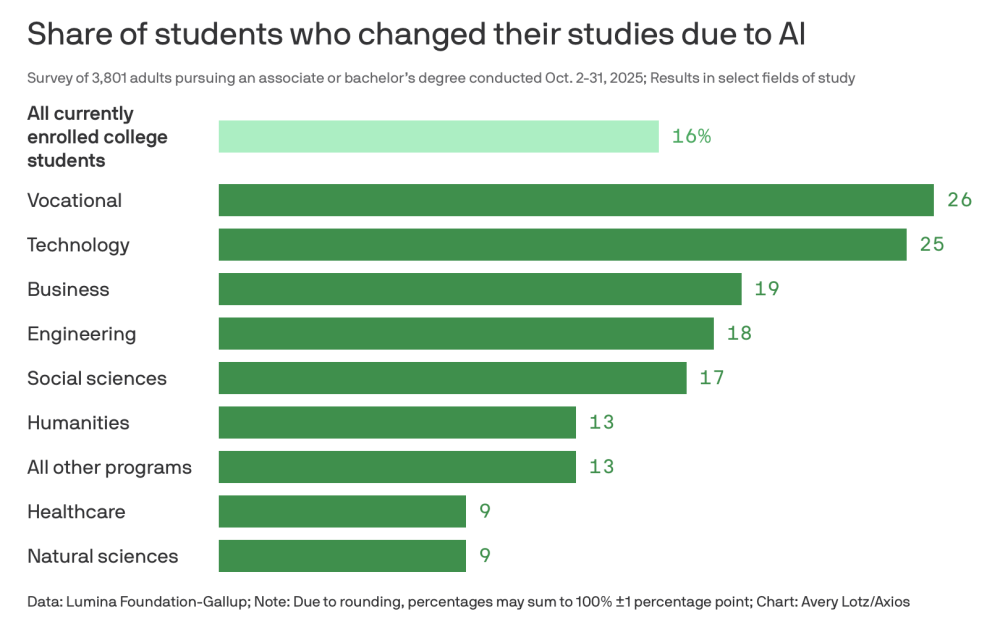
AI is making college students change majors
by Avery Lotz | April 2, 2026 | Axios
“Nearly half of college students say they’ve thought at least a fair amount about changing their major or studies because of AI’s potential impact, according to newly released polling.
The big picture: College graduates are entering a job market that’s been rocked by a massive tech evolution, reshaping career prospects for entry-level workers.
And as the new survey from Lumina Foundation and Gallup notes, AI isn’t just impacting how academics study — it’s also determining the studies they pursue.
By the numbers: Among currently enrolled college students, 14% have thought “a great deal” and 33% have thought “a fair amount” about changing their major or field of study because of the effect AI may have on the job market or on specific industries, the polling found.”
New Research from Pearson Points to the Value of AI in the Humanities & Earth and Social Sciences
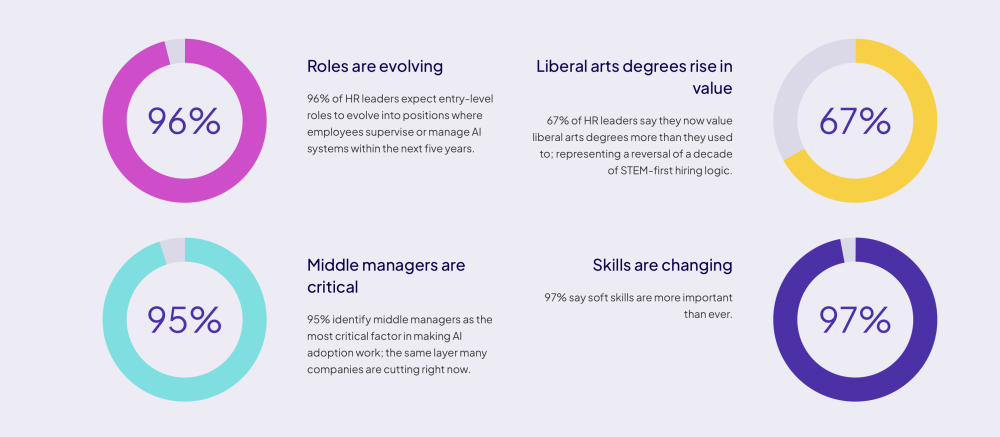
According to new research from Pearson captured in “The AI Workforce Pulse: The Adaptability Imperative”, entry-level roles are not disappearing — they are being redefined. As AI takes on routine tasks, organizations are shifting toward roles that require adaptability, human judgment and AI fluency. This research, based on a global survey of HR leaders, explores how leading organizations are evolving their workforce strategies — and where many are falling behind.
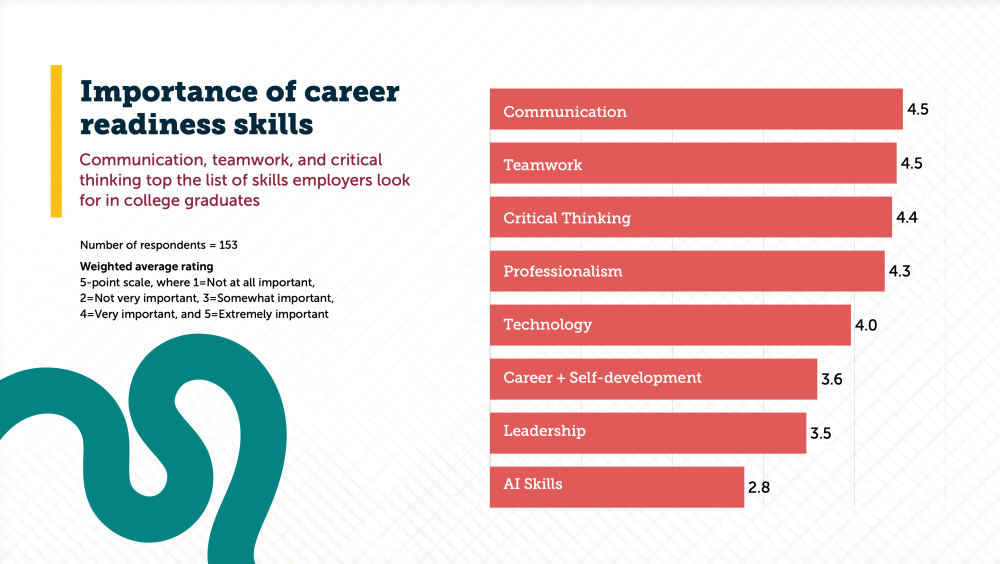
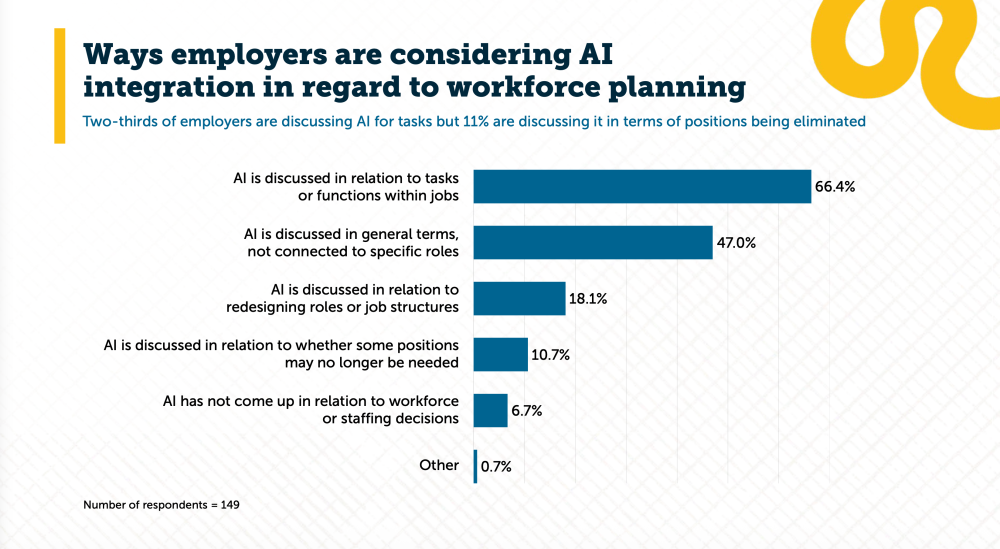
The Spring 2026 National Association of Colleges + Employers Job Outlook Report
Employers across the United States continue to find value in graduates with essential human skills centered around critical thinking, teamwork and team-building, collaboration, problem solving, communication, and the central skills offered by humanities and social sciences disciplines in CHESS. Increasingly, employers are also asking new hires to work with AI technology in responsible and ethical ways, develop intentional AI workflows for specific tasks, and leverage AI tools to problem solve and accomplish goals. With HCAI, students will have every opportunity to prepare for the post-graduation success vision they want to pursue.
The Humans at the Center of Human-Centered AI
| Justin Cary Program Director, Human-Centered AI jcary1@charlotte.edu | |
| Dr. Yash Tadimalla Lecturer, Computer Science Representative, HCAI Steering Committee Faculty member teaching in HCAI stadimal@charlotte.edu | |
| Mary F. McKenzie Assistant Dean of Curricular Competency and Experiential Learning for the College of Humanities & Earth and Social Sciences Representative, HCAI Steering Committee mfmckenz@charlotte.edu | |
| Dr. Helen Davies Assistant Professor, Department of English and School of Data Science Representative, HCAI Steering Committee hdavies4@charlotte.edu | |
| Dr. Marianna Ganapini Associate Professor of Philosophy and Data Science Representative, HCAI Steering Committee mbganapini@charlotte.edu | |
| Aileen Benedict Lecturer, Computer Science Faculty member teaching in HCAI abenedi3@charlotte.edu | |
The Human-Centered AI Charter
Humans working, thinking, and learning together to navigate the educational, ethical, social and technological landscape of artificial intelligence.
Niner Knowledge Presentation | March 2026
“Hidden Gems: From Prompting to Partnerships in Everyday AI”